


Seller-paid buydowns: fixing the payment instead of the price
- October 23rd, 2026
- 12 min read
Guest guide · Financing a purchase
Seller-paid buydowns: fixing the payment instead of the price
When rates are high, the monthly payment is often what stops a deal. Here is how a seller-paid buydown works, with a worked example.
By Brad Malkin, President of Noble Home Loans, with Bryce Edwards, Realty ONE Group · Updated October 22, 2026 · 7 min read
The short answer
- A buydown puts the seller’s money toward your monthly payment instead of the price.
- In the example below, an $11,438 buydown beats a $30,000 price cut for the first two years. The payment is $463 a month lower in year one, and the seller keeps about $18,562 more before selling costs.
- The catch: from year three on, the payment is about $168 a month higher than with the price cut. You have to qualify for that full payment from day one.
When mortgage rates are high, a willing buyer and a motivated seller can still end up miles apart. The seller is focused on what the home is worth and what they will walk away with. The buyer is focused on what owning that home will cost every month. Both concerns are reasonable. The challenge is getting them to meet.
A seller-paid mortgage buydown can be the great equalizer. By putting a negotiated seller contribution toward the buyer’s financing, it can deliver meaningful payment relief while allowing the seller to accept a smaller concession than a substantial price reduction. The opportunity is to solve the payment problem directly.
01
Why many sellers have little incentive to negotiate
Many sellers bought or refinanced when mortgage rates were below 4%. Moving can mean surrendering that inexpensive financing and taking on a much higher payment for their next home. Accepting a lower sale price reduces their proceeds just as their borrowing costs increase. For an owner who does not need to move, that opportunity cost can make staying put the better financial choice.
That helps explain why many sellers are less negotiable: they may want to sell, but they do not have to. Meanwhile, buyers can reasonably struggle with the payment. Even a $30,000 price reduction may not deliver enough monthly savings to close the gap. A buydown gives both sides another option to evaluate.
In plain English
Many sellers have a low-rate mortgage they don’t want to give up, so they won’t cut the price much. Buyers care most about the monthly payment. A buydown gives both sides another way to make the deal work.
02
How a seller-paid buydown works
Terms you’ll see
With a temporary buydown, the seller funds an account at closing that covers part of the buyer’s scheduled mortgage payments for a defined period. The buyer pays the rest. A common option is a 2-1 buydown: the buyer’s portion is calculated using a rate two percentage points below the note rate in year one and one point below it in year two. The buyer pays the full scheduled amount beginning in year three.
The loan’s actual interest rate remains unchanged. The seller-funded subsidy covers part of the full scheduled payment during the first two years. It does not reduce the loan’s contractual interest rate or APR. Buyers must understand what they will pay after the assistance ends.
A permanent buydown works differently. Seller funds pay discount points to obtain a lower interest rate. On a fixed-rate mortgage, that lower rate lasts for the life of that loan. The cost depends on lender pricing; there is no universal rule that a particular dollar amount buys a specific rate reduction.
In plain English
Temporary buydown: the seller helps with your payment for two years, then you pay the full amount. Permanent buydown: the seller pays to lower your rate for as long as you keep the loan.
03
A short Las Vegas illustration
Consider a hypothetical $600,000 home. Compare a $30,000 price reduction with keeping the price at $600,000 and funding a 2-1 buydown. Both examples assume a conventional first mortgage for a primary residence, a 30-year fixed term, and 20% down. The table shows each payment stage and its duration.
| Comparison | $30,000 price reduction | Seller-funded 2-1 buydown |
|---|---|---|
| Fixed rate and annual percentage rate (APR) | 7.50% fixed note rate · 7.50% illustrative APR | 7.50% fixed note rate · 7.50% illustrative APR |
| Purchase price | $570,000 | $600,000 |
| Down payment and loan | $114,000 down (20%) · $456,000 loan | $120,000 down (20%) · $480,000 loan |
| Seller buydown contribution | $0 | Approximately $11,438 |
| Months 1–12 · 12 monthly payments | $3,188.42 | $2,725.39 |
| Months 13–24 · 12 monthly payments | $3,188.42 | $3,033.93 |
| Months 25–360 · 336 monthly payments | $3,188.42 | $3,356.23 |
Payments shown are monthly principal and interest only. They exclude property taxes and homeowners insurance; the actual payment obligation will be greater. HOA dues, if applicable, are additional. The buydown column shows the buyer’s portion; contractual principal and interest remains $3,356.23 for all 360 months, with the seller-funded account covering the difference in months 1–24. The 7.50% illustrative APR assumes no borrower-paid discount points or other prepaid finance charges, no mortgage insurance, and a first payment one month after funding. Actual fees can increase APR. Figures are rounded. This educational example is not a current rate quote or commitment to lend. Payments use standard 360-month amortization. The buydown contribution equals 12 months of each annual payment difference from the full note-rate payment.
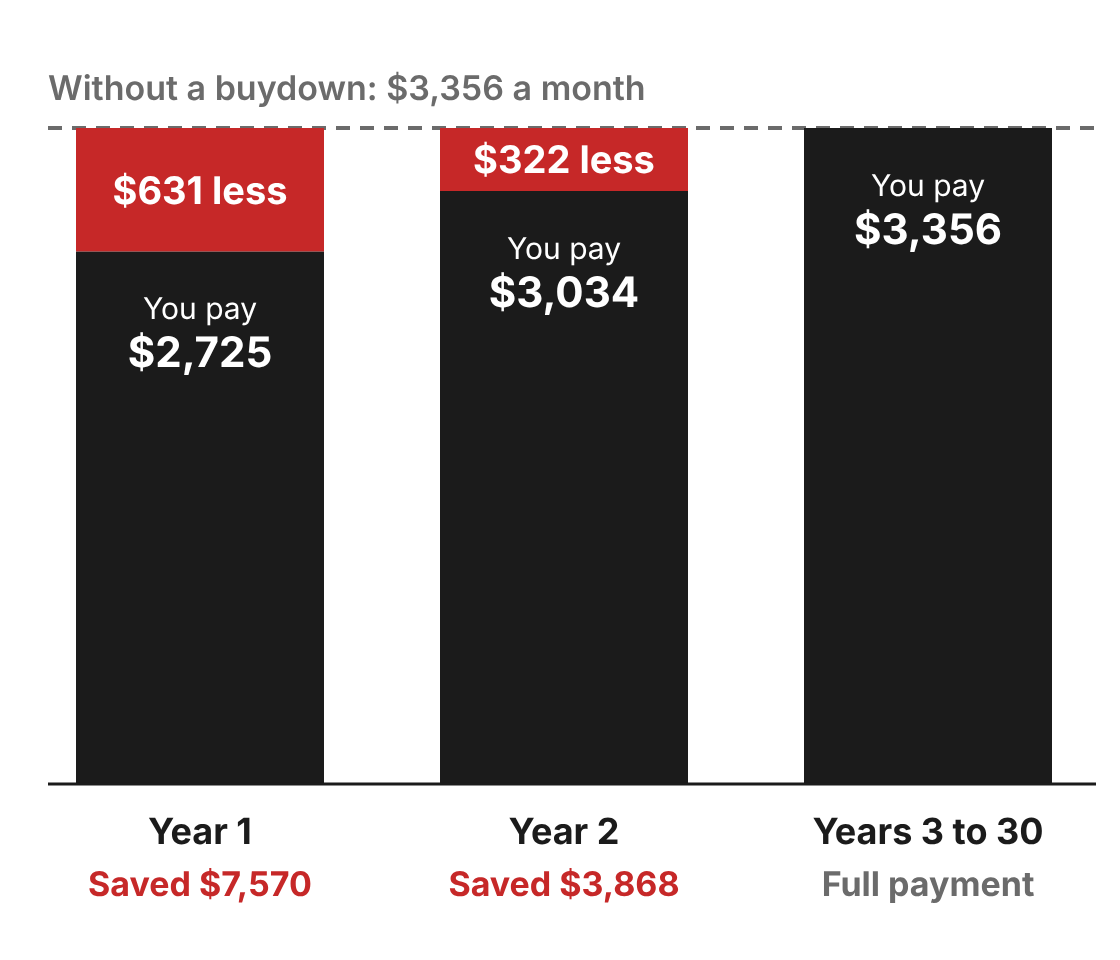
Your monthly payment, with and without the buydown
In plain English
The red part of each bar is paid by the seller’s buydown money, not by you. It adds up to $11,438 over two years. From year three on, you pay the full $3,356. Compared with the $30,000 price cut, the buydown costs you less for two years and about $168 a month more after that.
04
What the buyer and seller gain
For the buyer, the buydown provides about $631 in monthly relief during year one and $322 during year two compared with purchasing at $600,000 without assistance. Compared with the $30,000 price reduction, the buyer pays approximately $463 less per month in year one and $154 less in year two.
For the seller, the buydown costs approximately $11,438 instead of conceding $30,000. That leaves about $588,562 after the buydown contribution, versus $570,000 with the price reduction: roughly $18,562 more before commissions, other selling costs, and mortgage payoffs. Actual net proceeds will reflect those expenses.
A seller-paid buydown may be the best way to bring the buyer’s initial payment into a comfortable range while making the seller’s credit acceptable. In some transactions, it may also be the only way to reach an agreement: the price reduction needed to deliver comparable payment relief is simply more than the seller will accept. Directing a smaller concession toward the payment can help both sides move forward. The buyer must still weigh the larger loan and the full payment after the two-year subsidy ends, about $168 more per month than the price-reduction option in this example.
05
Choose the structure that fits the buyer
Temporary payment relief can help buyers preserve cash during the expensive transition into a home. But buyers must qualify at the full note rate and be comfortable with the full payment. A future refinance should be a possible opportunity, never the foundation of the purchase. Rates may not fall, and refinancing depends on eligibility and costs.
A future refinance should be a possible opportunity, never the foundation of the purchase.
For buyers prioritizing lasting payment savings, compare a permanent buydown with the price reduction using actual lender quotes and the expected time they will keep the loan. Sometimes a combination of a price adjustment and a seller credit offers the best fit.
Seller contributions have program-specific limits and must be properly documented. They cannot replace the required down payment. The home must also support the purchase price through the lender’s appraisal requirements. A buydown can improve the terms of a fairly priced home; it cannot make an unsupported price reasonable.
In plain English
Before you choose a buydown, make sure you can afford the full payment from day one. Don’t count on refinancing later. And a buydown can’t fix a home that is priced too high.
06
Bring the payment into the negotiation
Before lowering a list price or walking away from a home, compare the options side by side. Look at the seller’s estimated net proceeds, the buyer’s cash needed at closing, and the payment both during and after any buydown.
Bryce Edwards with Realty ONE Group and I can help you evaluate the real estate and financing sides together. Bryce brings the pricing and negotiation perspective; at Noble Home Loans, we can calculate the financing alternatives. When the obstacle is the monthly payment, that conversation can give a buyer and seller a practical path to agreement.
07
Questions buyers and sellers ask
Does a temporary buydown lower my interest rate?
No. The loan’s actual interest rate remains unchanged. The seller-funded subsidy covers part of the full scheduled payment during the first two years. It does not reduce the loan’s contractual interest rate or APR.
What payment do I need to qualify for?
Buyers must qualify at the full note rate and be comfortable with the full payment.
What is the difference between a temporary and a permanent buydown?
With a temporary buydown, the seller funds an account at closing that covers part of the buyer’s scheduled mortgage payments for a defined period. With a permanent buydown, seller funds pay discount points to obtain a lower interest rate. On a fixed-rate mortgage, that lower rate lasts for the life of that loan.
How much does a permanent buydown cost the seller?
The cost depends on lender pricing; there is no universal rule that a particular dollar amount buys a specific rate reduction.
Should I plan to refinance when rates drop?
A future refinance should be a possible opportunity, never the foundation of the purchase. Rates may not fall, and refinancing depends on eligibility and costs.
Is there a limit on how much a seller can contribute?
Yes. Seller contributions have program-specific limits and must be properly documented. They cannot replace the required down payment.
Connect with Bryce and Brad

Bryce Edwards
Realtor, Realty ONE Group · Las Vegas
Las Vegas Realtor since 2013. More than $25M in sales across Summerlin, Red Rock Country Club, Henderson and the Strip high-rises. 2025 top-producer award, Realty ONE Group. My family and I live in Summerlin.
Your next step
Weighing a price cut against a buydown?
Tell me the home you’re looking at. I’ll lay out the price-cut and buydown options side by side, and Brad can run the financing numbers.
Or text or call (702) 412-5524
bryce@luxuryvegashouses.com
Brad Malkin
President, Noble Home Loans · NMLS 100539
Cell 702-279-9111
brad.malkin@noblehomeloans.com
NobleHomeLoans.com
Noble Home Loans | NMLS 328275 | Equal Housing Opportunity. Subject to credit approval, program availability, and applicable seller-contribution limits.

Private golf clubs in Las Vegas: how membership works when you buy

How far each Las Vegas community is from a hospital ER